
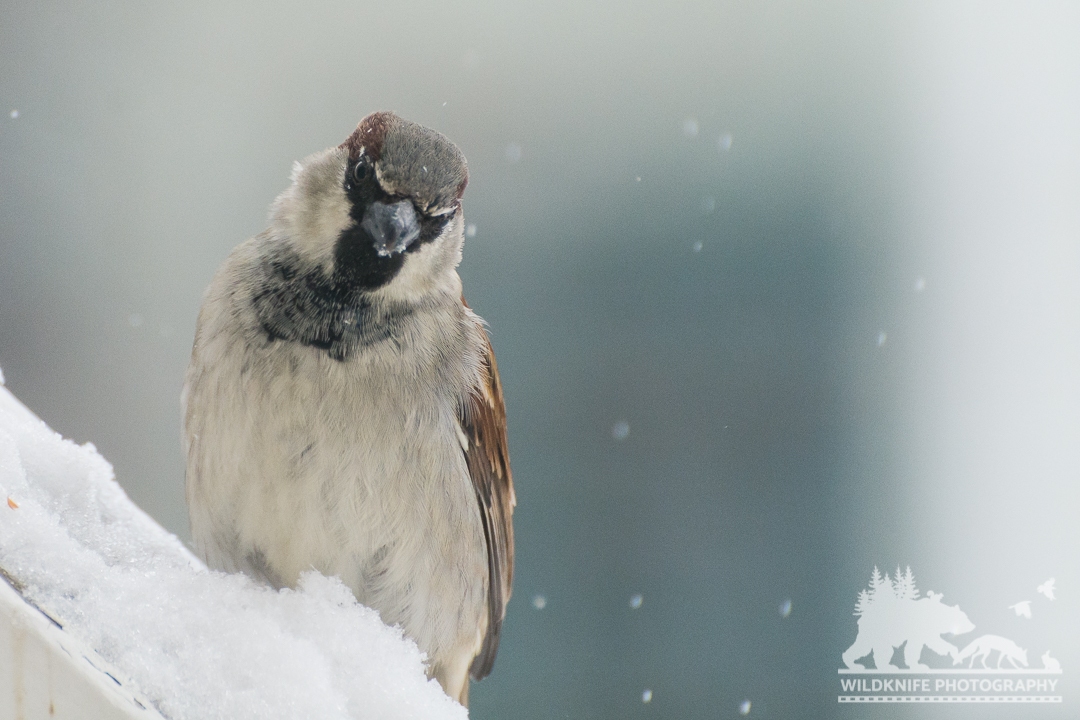


As you may already know, house sparrows are not native to North America. They are members of the Old World sparrows and were introduced to this continent by a number of enthusiastic yet misguided bird lovers.
Lots of sparrows were imported and set loose in Brooklyn, New York, in 1851. By 1900 the birds had spread to the Rocky Mountains. Two more introductions in the west during the early 1870s helped the sparrow expand its range even further. House Sparrows are common across all of North America with the exception of Alaska and the farthest parts of northern Canada.
Part of the reason the House Sparrow is so successful is that it prefers to nest in man-made structures such as eaves or walls of buildings, street lights, and nest boxes rather than natural nest sites such as holes in trees.
They often begin breeding in March which means that they claim suitable nesting spots before native birds arrive from the south. A pair of mated sparrows may raise up to four broods each year, with as many as six eggs at a time so they can occupy these nesting sites through August.
The House Sparrow is one of the most studied birds because of its proximity to and lack of fear of humans. There have been almost 5,000 scientific papers published with the House Sparrow as the study species.
The abundance of the house sparrow and their ability to thrive alongside humans has earned them a distinguished place on the invasive species list. Eradication programs have been in place in many parts of North America in an attempt to eliminate the negative economic impact House Sparrows have had on the agriculture industry.
Recently, House Sparrows have been disappearing. A number of hypotheses have been put forward to suggest a cause however nothing has been proven conclusively to date. Some of the theories about what is causing their drop in numbers include; respiratory failure from increased air pollution, cats, pesticide poisoning, falling numbers leading to a breakdown in the social structure, or avian malaria. In Europe, the House Sparrow population has declined by 71%. Sparrows have vanished from many parts of London where they have been nesting for centuries.
The oldest recorded House Sparrow was a female, and at least 15 years, 9 months old when she was found in Texas in 2004, the same state where she had been banded.
I hope you enjoyed this week’s story about the love-hate relationship we have with the House Sparrow.